A water treatment system doesn’t have to look like a piece of industrial equipment hiding beneath your kitchen sink.
For many homeowners, that’s actually part of the appeal of modern reverse osmosis systems. They can provide treated water for drinking and cooking while fitting neatly into a space that’s already crowded with cleaning supplies, plumbing, and the occasional mystery item nobody remembers putting there.
But appearance isn’t the only consideration.
The best system is one that matches the water, household demand, available space, maintenance habits, and the way you actually use your kitchen. A beautiful installation that doesn’t produce enough water isn’t particularly useful. Neither is an inexpensive system that requires constant attention.
Fortunately, today’s RO equipment offers enough flexibility to make a practical setup possible for many different homes.
Start With Your Water
Before thinking about cabinets, faucets, or filter configurations, understand the water you’re treating.
A water test can reveal characteristics such as hardness, total dissolved solids, chlorine, sediment, iron, and other factors depending on the analysis.
That information helps determine what kind of pretreatment is necessary and whether reverse osmosis is the right technology for the job.
This step is easy to skip because equipment is more interesting than laboratory results.
Still, it can save money.
If the source water contains conditions that could affect membrane performance, appropriate pretreatment can protect the RO system and help it operate more consistently.
Flexibility Makes Installation Easier
Not every kitchen has the same plumbing arrangement.
One home might have plenty of cabinet space. Another might have a shallow cabinet with plumbing taking up most of the room.
That’s why having any filter combination available can be useful when configuring an RO system around specific water conditions and installation requirements.
A household may need sediment filtration and carbon filtration before the membrane. Another may require a different arrangement based on its source water.
The point isn’t to install every available filter.
It’s to choose the combination that makes sense.
More stages aren’t automatically better if they don’t address an actual water-quality concern.
The Cabinet Doesn’t Have to Look Like a Workshop
Let’s be honest: appearance matters.
The kitchen is one of the most visible rooms in the house, and homeowners don’t necessarily want treatment equipment to make the space feel cluttered or unfinished.
An attractive white box enclosure can provide a cleaner appearance for certain RO configurations, helping the equipment blend into the surrounding kitchen environment.
It’s a small design consideration, but small things become noticeable when you interact with them every day.
A system that looks organized is also easier to live with.
Of course, appearance should never replace function. The enclosure still needs to provide access for filter replacement and service.
The Faucet Is Part of the Experience
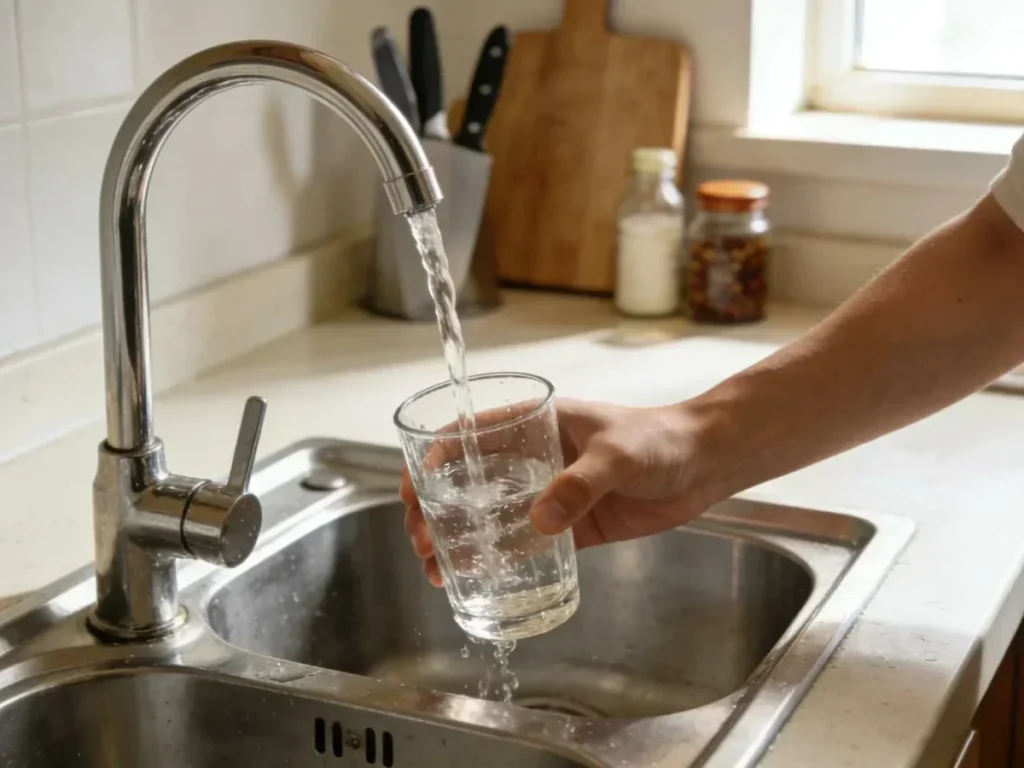
The dedicated RO faucet is where all the technology becomes very simple.
You turn it on, fill a glass, and drink.
Because the faucet is used frequently, its location and design deserve some thought.
It should be convenient enough that nobody has to reach across the sink or move dishes out of the way just to fill a bottle.
Style matters, too.
Modern kitchens often have carefully selected fixtures, so homeowners may not want a generic-looking faucet sitting beside an otherwise polished sink.
For those who want a more coordinated appearance, designer style NSF certified colored faucets available can provide options that combine visual appeal with appropriate certification considerations.
The key is to confirm exactly what the certification covers and ensure the faucet is suitable for the intended drinking-water application.
Storage Capacity Should Match Your Routine
RO systems often rely on a storage tank because the membrane produces treated water gradually.
That stored water is then available when someone opens the dedicated faucet.
Think about how your household uses water.
Do you fill several bottles every morning? Do you use RO water for cooking? Do you make coffee multiple times a day? Is there a large family sharing the kitchen?
Those habits can influence the amount of storage you’ll want.
A small household may be perfectly comfortable with modest storage. A larger family may need greater capacity or a higher-production configuration.
The goal isn’t to choose the largest tank available.
It’s to have enough treated water available when you actually need it.
Don’t Ignore Water Pressure
Pressure is one of the less exciting but more important parts of RO performance.
Reverse osmosis requires sufficient pressure to push water through the membrane.
If household pressure is low, production can slow. The storage tank may take longer to fill, and the faucet can feel disappointing during periods of high demand.
A booster pump may be appropriate in some installations.
Before choosing equipment, have the water pressure checked and compare it with the system’s operating requirements.
A system that is correctly configured for the available pressure is much more likely to deliver the experience you expect.
Filter Maintenance Should Be Convenient
Filters eventually need replacement.
There’s no getting around that.
The good news is that a well-designed system can make the process straightforward.
Filters should be accessible without requiring complicated disassembly. Connections should be easy to identify, and replacement parts should be readily available.
If replacing a cartridge becomes a major project, homeowners are more likely to delay it.
That can affect performance.
A clogged sediment filter can reduce flow. A depleted carbon filter may provide less effective pretreatment. An aging membrane may produce water more slowly.
Simple maintenance is one of the best forms of prevention.
Certification Is Worth Understanding
Water treatment products often mention certifications, but consumers should look beyond the label.
Find out what component has been certified and under which standard.
Certification may apply to a faucet, tubing, filter material, or complete system depending on the product.
This distinction matters because one certified component doesn’t necessarily mean every part of an assembled system has the same certification.
A reputable supplier should be able to explain what has been evaluated.
That’s useful information when the equipment is intended to produce water for drinking and cooking.
Water Efficiency Matters Too
Reverse osmosis systems can send some water to the drain during operation.
The amount varies according to system design and operating conditions.
If conserving water is important to your household, ask about the system’s recovery ratio and expected wastewater.
Membrane condition, water pressure, temperature, and maintenance can all influence performance.
Modern systems can be designed with efficiency in mind, but efficiency shouldn’t be assumed simply because a product is new.
Ask questions.
A good installer should be able to explain how the system is expected to perform under your home’s conditions.
Installation Is More Than Connecting a Few Tubes
Under-sink RO installation may look simple from the outside.
In reality, the system needs appropriate connections for incoming water, treated water, drainage, and sometimes storage or electrical components.
Tubing needs to be routed cleanly. The faucet needs a suitable mounting location. Components need enough room for future maintenance.
A neat installation also reduces confusion later.
If a filter needs replacing six months from now, you should be able to identify the components without needing a flashlight, a diagram, and a small amount of courage.
Choose for the Long Term
The cheapest system isn’t necessarily the least expensive option over time.
Consider replacement filters, membrane life, maintenance, water usage, service requirements, and installation costs.
A slightly more expensive system that is easier to maintain and better suited to your water may prove more economical in the long run.
The same goes for aesthetics.
If you dislike the appearance of a system, you’ll notice it every day. If the faucet doesn’t match your kitchen, that tiny annoyance may grow.
Good design considers both performance and everyday experience.
A Better Kitchen Doesn’t Need More Complication
Reverse osmosis works best when it quietly fits into your routine.
The system should provide treated water when you need it, operate efficiently, remain accessible for maintenance, and look reasonably at home in the kitchen.
That starts with understanding your water and choosing equipment around your actual needs.
From filter configuration to storage capacity, from pressure requirements to faucet design, each detail has a role.
None of it needs to feel overwhelming.
The smartest approach is simply to ask practical questions before installation and choose a system that answers those questions well.
When everything is configured properly, the technology fades into the background.
You fill your glass. You make your coffee. You cook dinner.
And the only thing you really notice is that the water tastes the way you want it to.